
Finding Residents Across Moline Records
A useful Moline search starts with the record that fits the known detail. Enter a street or owner in Rock Island County Assessment Search when a parcel is involved. Use the Illinois voter lookup only when the person can supply the required identity and address fields. Search Judici for a court party, the County Clerk genealogy indexes for an older birth, marriage, or death, and Moline Public Library or the Rock Island County Historical Society for a past household. Each source describes a role, such as owner, voter, litigant, licensee, or directory householder. It does not automatically prove present residence.
Write down the spelling, date, source URL, record number, and address exactly as shown. A second independent source should agree before two entries are treated as the same person. Renters, family members who own no parcel, people protected by confidentiality rules, and residents absent from a printed volume can remain outside these public rolls.
- Search the county parcel roll by owner, PIN, or situs address.
- Check the narrow Illinois voter registration lookup when its required fields are known.
- Carry the PIN or legal description into the Recorder's deed index.
- Use city directories, newspapers, probate, and cemetery records for an older trail.
- Ask the custodian or file an Illinois FOIA request for a public record that is not online.
Where Moline Resident Records Live
Moline is the county's largest city, but Rock Island is the county seat. The Recorder, Assessment Office, and County Clerk operate at the county administration building, while the Circuit Clerk works from the courthouse. Their standard posted hours are weekdays from 8:00 a.m. to 4:30 p.m. The city separately keeps municipal records, permits, cemetery maps, and service-request material. Choosing the custodian first prevents a city request from being sent for a county deed or court file. The address-based method is developed further in the Moline street directory.
Rock Island County Assessment Office
1504 Third Avenue
Rock Island, IL 61201
309-558-3660
Search Moline Parcels Three Ways
The DEVNET wEdge parcel portal is the strongest current starting point when a name or address is tied to real estate. Its basic search accepts owner name, parcel identification number, and situs-address criteria. Advanced controls include taxpayer address, neighborhood, subdivision, township, taxing district, property class, sale date, sale price, and acreage. Results can be narrowed to Moline Township and displayed in pages of 25 rows. The detail record includes assessment, tax, legal-description, sales, map, and genealogy views.
| Portal field | Best use | Important limit |
|---|---|---|
| Owner name | Find titled parcels | Name may be an entity |
| PIN | Anchor one legal parcel | Not a person identifier |
| Situs address | Find the physical property | Does not list every occupant |
| Taxpayer address | See where a bill is sent | May be outside Moline |
| Sale filters | Narrow transfer history | Recorder document controls |
The portal's working-file disclaimer matters. Records change and are not warranted for accuracy, and the site bars automated extraction. The saved PIN and legal description are more dependable handoff keys than a name alone. This is the practical value of a parcel result in a Moline residents directory.
Moline Mailing Clues Need Proof
A parcel card separates the situs, the land's physical location, from the owner's mailing address. Those addresses can match, but they do not have to. A tax bill may go to an agent, an organization, or an owner outside Illinois. That difference is useful because it suggests another location or spelling to check, yet it cannot establish that the named owner lives in the Moline house.
Record terms
Roll: an official list made for a public task. Index: a finding aid that points to a record. Parcel: a legally described tract with a PIN. Criss-cross directory: a volume arranged by address instead of only by surname.
Compare the parcel name with a dated deed, directory entry, court record, or another lawful source. Keep separate notes for mailing and situs addresses. That small habit prevents a frequent resident-search error.
Current Moline Directory Sources
No single government list functions as a complete Moline residents directory. Several official indexes answer narrower questions, and each has its own access rule. Property and license searches are broadly available. The public voter form verifies one registration from detailed inputs, while the fuller voter file is limited by Illinois law. Recorder portals may charge or require an account. Court documents can also be restricted by case type.
| Source | Who It Lists | Keeper | Access |
|---|---|---|---|
| DEVNET assessment roll | Parcel owners and taxpayers | County Assessment Office | Free individual search |
| Illinois voter lookup | One registered voter | State Board of Elections | Required identity fields |
| Laredo and Tapestry | Parties to recorded documents | County Recorder | Account or paid access |
| Judici case index | Public court parties | Circuit Clerk | Free portal and terminal |
| IDFPR license lookup | Licensed people and entities | Illinois IDFPR | Free, updated daily |
Use the role shown by the source. A parcel owner is not necessarily an occupant, and a court party is not necessarily the person with the same name found elsewhere. Compare dates, addresses, case numbers, relatives, and license details without merging unrelated people.
Moline Deeds Extend the Trail
The Rock Island County Recorder holds deeds, mortgages, liens, plats, releases, and other land records back to the mid-1800s. Start with the current parcel PIN and legal description, then search the latest recorded deed. Record the grantor, grantee, document number or book and page, date, and legal description. The prior owner can then be searched as an earlier grantee. Repeat the chain while the legal description continues to match.
The Recorder's official page links Laredo and Tapestry, but it does not state the online index cutoff. Laredo is account based and Tapestry is pay as you go. When an older document is absent online, visit the office, or request it by mail or fax. Some categories cannot be handled by phone. The office's large imaging project merged and scanned about 2,500 bound books, so an index hit and an available image may still have different coverage.
The county's free Property Fraud Alert can send an email or phone notice when a document is recorded under a subscribed name. It is a monitoring aid, not a block on filing and not a substitute for title advice.
Confirm Moline Court Name Matches
Rock Island County links its public circuit-court search through Judici. The verified search capability includes party names, case numbers, record-sheet entries, and public documents. For traffic matters, the county advises entering the ticket name as Last, First, including the space after the comma. The live form presented hCaptcha during research, so its current field labels should not be guessed.
The fallback is unusually clear. A public-access computer at the Circuit Clerk's office shows publicly available information and documents. Standard copies may be emailed, picked up, or mailed; certified copies carry a raised seal and must be picked up or mailed. Give staff the case number, party names, approximate year, and case type. Juvenile, adoption, sealed, expunged, and other confidential material is not public. A missing online result does not prove that no case exists.
The Circuit Clerk converted 28,892 files and 90 index books during its move toward electronic access. That history helps explain why an older case may have index data without a remotely viewable image.
Moline Genealogy Before Certificates
The Rock Island County genealogy search is often a better first test for an older family than ordering a certificate. Its marriage index runs through 1975, its death index through 2005, and its birth coverage is governed by the county's published genealogy limits. A $5 uncertified copy on ordinary paper can reveal items such as occupation, residence, spouse, parents, burial, or cause of death when present.
That product is for research, not legal use. Certified birth, death, and marriage copies remain limited to eligible requesters and require identification. County certified fees also differ by record: the first birth or marriage copy is $15, while the first death copy is $20. IDPH handles some state services and verifies marriage or dissolution facts, but certified marriage records come from the county clerk and certified divorce decrees from the Circuit Clerk. Always label an index, genealogy copy, verification, and certificate as different things.
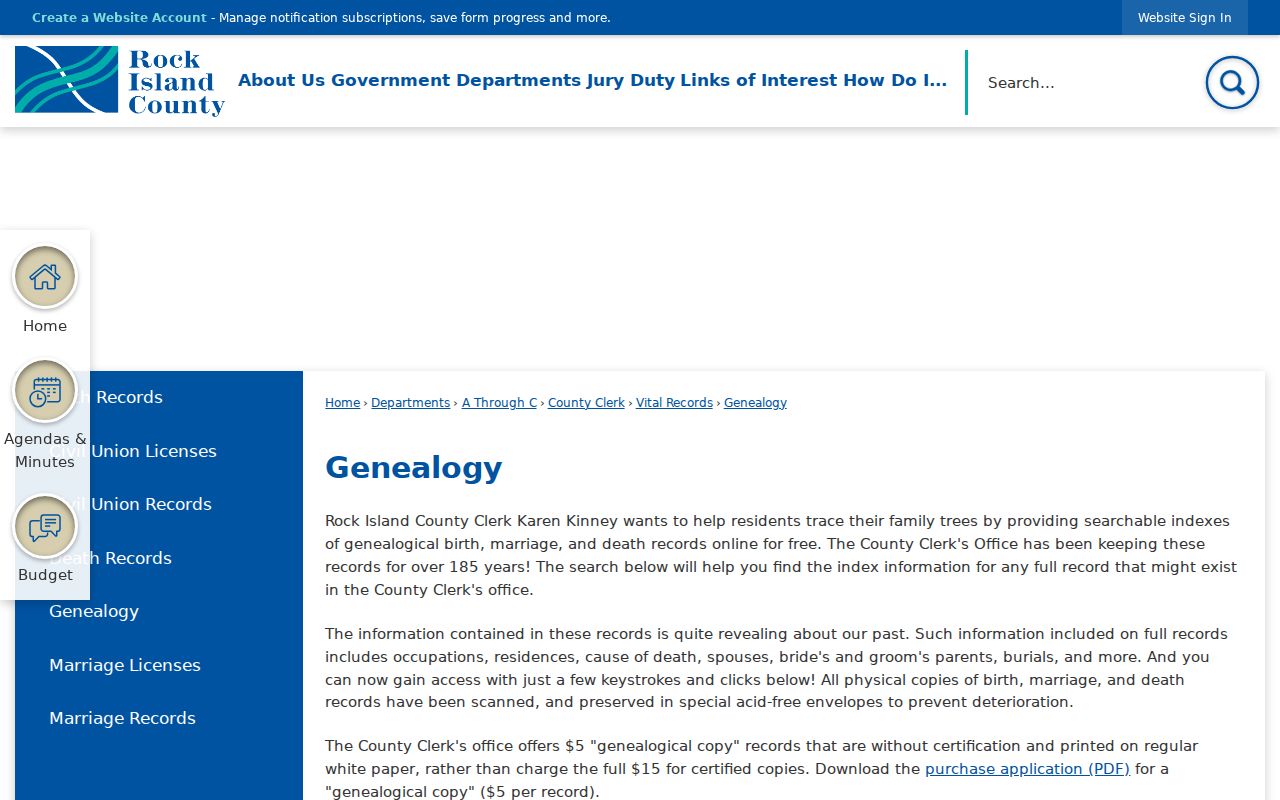
The county screen reinforces that genealogy access is a search aid with its own ranges and disclaimer, not an unrestricted vital-certificate portal.
Moline Voter Search Stays Narrow
The Illinois Online Voter Registration Lookup asks for first name, last name, date of birth, five-digit ZIP code, street number, and street name. That combination is designed to let a person check a specific registration and polling information. It is not a browseable roster of everyone on a Moline street.
Illinois law treats the fuller computerized voter file differently. Released lists may redact a street number, phone number, birth date, Social Security number, and identifiable email. The State Board says voter data is available to registered political committees for bona fide political purposes and for limited federal voter-list purposes, not personal or commercial solicitation. Address changes and registration questions can also go through the County Clerk rather than the public form.
Use resident records for lawful personal research. Never use an address trail to stalk, harass, threaten, or harm anyone.
Moline Maps Separate Public Layers
County and city GIS tools answer different questions. Rock Island County maps parcel boundaries, address points, streets, voter precincts, and taxing districts. Moline GIS publishes city service, ward, neighborhood, cemetery, Sanborn, and historic-map tools. A click on either map should be labeled with the agency that owns the layer because “GIS” is not one shared database.
Moline's Informative Web Maps list is the safest starting hub for current city applications. The resident-information map can connect an address with city service details, while county parcel data carries the PIN and legal description needed for a deed search. The older county viewer is marked for retirement, so its visible data should be checked against the current county and city links.
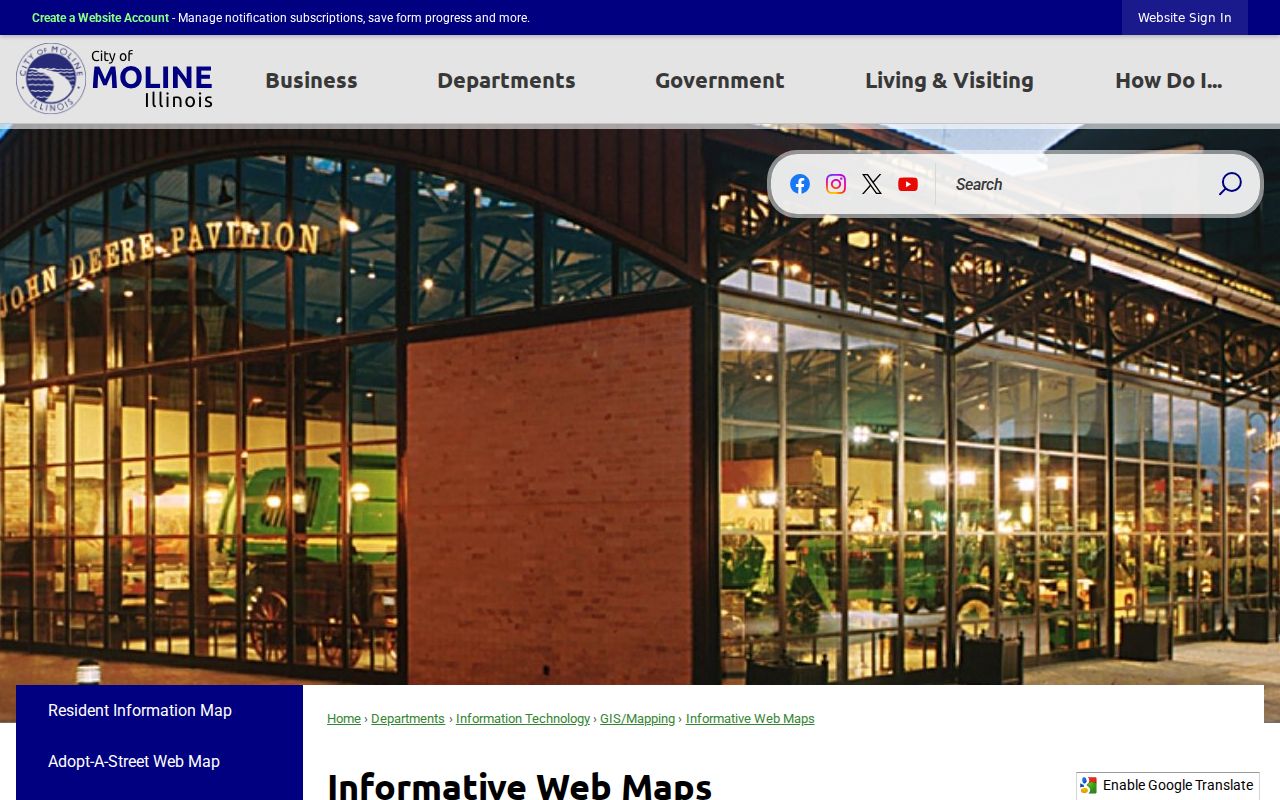
The application list shows why a map result must be matched to the record purpose, whether that is a parcel, neighborhood, cemetery, or historic block.
Moline Directories Track Earlier Years
Printed city directories add the household layer that modern parcel rolls cannot. Verified Moline runs include Holland's Rock Island and Moline directories from 1878 through 1885, an H. N. Stone volume from 1902, and R. L. Polk volumes for 1909, 1917, and 1918. A Moline library example also points to a combined 1899–1900 directory. Exact scan and reverse-directory availability varies, so a missing year should be checked in a catalog rather than assumed lost.
Entries may show a person, spouse marker, occupation, employer, home address, business address, and abbreviation. Address or criss-cross sections, where present, reverse the process by putting the number first. Pair a directory year with the 1900, 1910, or 1920 census, a newspaper notice, and a deed. That can distinguish two residents with the same surname and reveal whether a move happened between annual volumes.
Historical Moline Directory Repositories
Moline Public Library provides local resources, digitized Moline High School yearbooks covering 1913 through 2022, newspaper links, and staff help. The Rock Island County Historical Society research library adds city directories, family files, newspapers, maps, and other local-history material. Its published access includes in-person research hours and a paid staff-research option. Illinois Regional Archives Depository holdings add probate, naturalization, deed, tax, court, and municipal collections by title and depository.
The full years, abbreviations, shelf locations, and tracing method belong on the Moline city directory collections page. For a quick Moline residents directory search, record the volume year and page, then compare the printed address with a census year or deed rather than treating the entry as timeless.
Moline Records Requests Fill Gaps
An unavailable portal is not the end of the search. Illinois FOIA normally requires a public body to respond within five business days, subject to a statutory extension. A requester generally does not need to explain the reason for asking. The first 50 standard black-and-white pages are free, after which a public body may charge up to 15 cents per page. Certified copies, unusual formats, and recorder or court products follow separate rules.
Moline accepts city FOIA requests through its published channels. County departments have their own FOIA officers, so send the request to the office that created or keeps the record. Describe the record, date range, address, case or parcel number, and desired format. Do not ask one office for “everything about” a person. A narrow request is easier to route and less likely to sweep in confidential material.
Recent Moline Access Changes
Moline launched a Resident Request Portal in April 2025 for nonemergency concerns, requests, and city services. It is open at all hours, but staff review submissions during business hours. In October 2025 the city announced digital permits with routes for permit searches, issued-permit reports, property searches, inspections, and contractor or license searches. The exact public fields and historical cutoff were not verified, so a city request remains the fallback for older address-based permit material.
Office details also change. Building Inspections reported a move to the City Services Center in 2026, while older pages can still circulate. Verify the current counter before traveling. Illinois court remote access also expanded in 2025, though the Rock Island clerk terminal remains the sound fallback for trial-court records. These dated changes are why every Moline directory note should include an access date.
Avoid Moline Record Scams
Official indexes and commercial people-finding products are not equivalent. An official roll has a named custodian, stated purpose, date, and correction path. A commercial result may merge old addresses, relatives, or people with the same name, and payment does not make that match official. Start with the free custodian index whenever one exists, then buy only the copy needed from the office that holds it.
Illinois I-Cash is a free state search for possible unclaimed property. The last name is required, while first name, address, city, ZIP, and property ID can narrow the search. A result is only a possible match; the claim process verifies identity separately. Property Fraud Alert is also free. Fake court calls, rushed payment demands, and claims that a public address guarantees identity should be reported through the appropriate court, police, Illinois Attorney General, or federal consumer channel.