
Walk a Moline Street
Start in the DEVNET assessment search, then preserve the PIN, situs address, owner, mailing address, legal description, and sale history. The Moline street directory works as a chain, not one query. A house number can identify one parcel, while an owner-name result may reach several properties.
- Search house number, street name, street type, and city.
- Browse adjacent parcels through county GIS.
- Carry the PIN to the Recorder.
- Use the voter lookup only for a known person.
- Ask a library for the correct reverse-directory year.
Keep the printed spelling, record date, and access date at every step. Compare the legal description when a corner parcel has more than one address. DEVNET is a current working file, a deed is dated, and a city directory represents its publication year. Combining those sources without dates can make a former owner appear current.
Moline Parcel Search Fields
DEVNET accepts PIN, owner, house number, street name and type, city, sale price, and sale date. Advanced controls add township, tax district, class, neighborhood, subdivision, acreage, and tax year. Results appear in 25-row pages and include an export option for individual inquiry.
| Field | Use |
|---|---|
| PIN | Joins tax, GIS, and deed records |
| Address | Finds one parcel or a street |
| Township | Separates Moline from South Moline |
| Sale filters | Narrows transfer activity |
See the assessment disclaimer before relying on a result. The working file changes, is not warranted for accuracy, and is not open to automated extraction. A PIN is a research key, not proof that an owner or occupant remains unchanged.
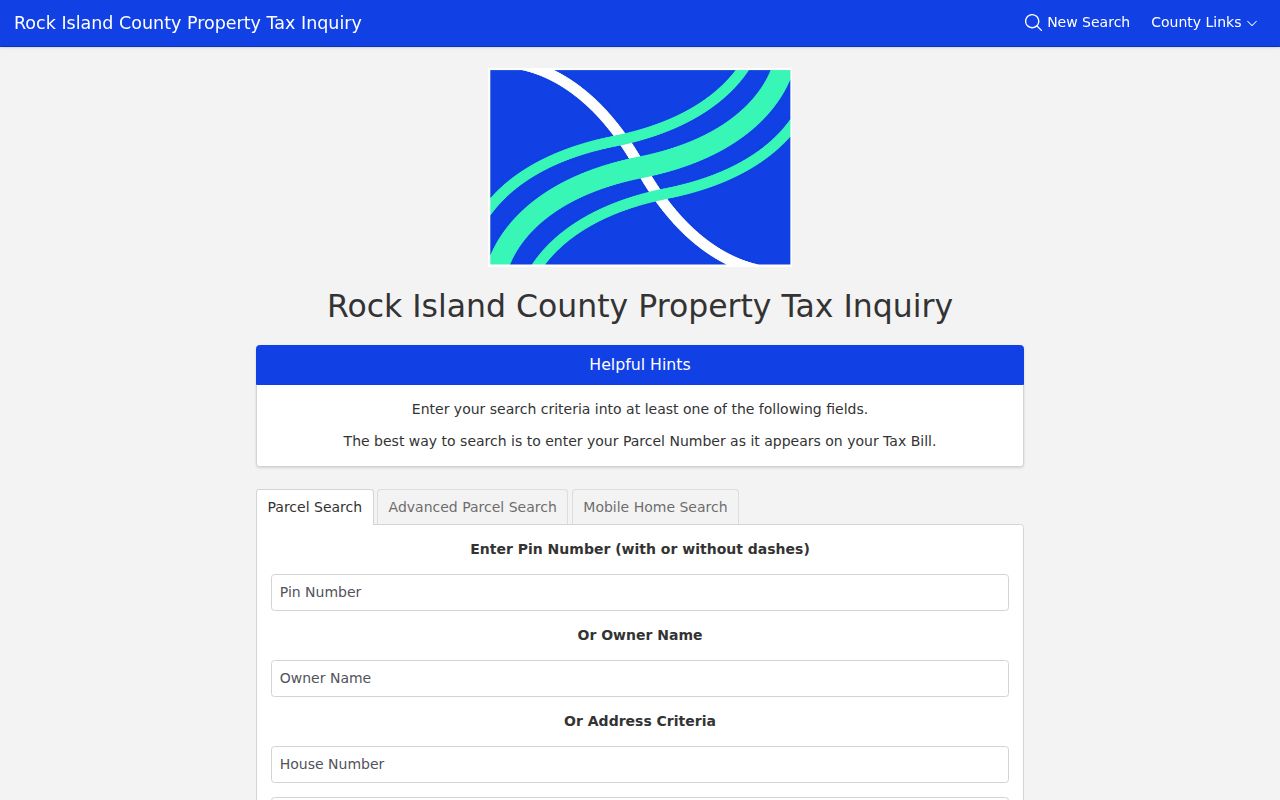
The captured form shows the by-address and advanced controls. Open a detail record for tax, assessment, sales, map, legal-description, and genealogy views, and note the tax year displayed.
Read Moline Address Types
Situs means the parcel's physical location. The mailing address is where the tax bill goes and may belong to an agent, organization, or owner in another state. A Moline street directory search must keep those columns separate. Mailing information is a clue, not proof that the recipient lives on the parcel.
- Parcel
- A mapped land unit with a PIN.
- Plat
- A recorded lot and block map.
- Criss-cross directory
- A volume arranged by address.
The legal description is the stronger bridge. Street labels and house numbers can change, while a lot, block, subdivision, or deed reference can connect the assessment card with recorded instruments. On a corner, check whether one parcel serves several addresses.
Map Moline Streets
County GIS maintains more than 65,000 parcels plus street, address-point, zoning, precinct, flood, school, fire, library, TIF, and aerial layers. Browse and click parcels along a road instead of assuming one text search captured each suffix. The legacy viewer is marked for retirement, so Moline GIS is a useful fallback.
The county maintains parcel and unincorporated address services. Moline GIS carries city wards, neighborhoods, cemetery tools, Sanborn maps, and resident-information layers. Label each result with its custodian. No public radius tool was verified, so click the visible adjacent parcels and save each PIN rather than claiming an automatic occupant list.
Moline Address Record Coverage
No source is a household roster. Each exists for a narrow public task. A property card identifies ownership and taxation, GIS locates mapped features, a deed records a transaction, and a permit documents city review.
| Record | Shows | Access |
|---|---|---|
| Assessment | PIN, owner, situs, mailing | Portal, office, request |
| GIS | Parcels and address points | Viewer or GIS desk |
| Deeds | Transfers and legal description | Portal, counter, mail, fax |
| Permits | Public permit facts | Portal or city FOIA |
Recorder holdings also include mortgages, releases, liens, and plats. Voter data is not a browseable street roll: the state form checks one known voter, and fuller files carry Illinois eligibility, use, and redaction limits.
Follow Moline Deed Records
Recorder holdings reach the mid-1800s, but the online cutoff is not stated. Laredo uses account access, while Tapestry is pay as you go. Their inspected screens did not establish the exact county search fields, so those details should not be guessed.
Start with the current PIN and legal description. Find the latest deed, save grantor, grantee, recording date, document number or book and page, then search the grantor as an earlier grantee. Recheck the land description after every parcel split or combination.
When online access stops, use the Recorder counter, mail, or fax. Some categories cannot be ordered by phone. This dated deed chain makes a by-street claim stronger than a name on a current tax screen alone.
Moline Permits Went Digital
The city launched online permits in October 2025 with permit search, issued-permit reports, property search, inspections, contractor search, and license search. These records can date work at an address. They do not name every person who used the building.
Historic coverage and exact public fields were not verified. Use a focused Moline FOIA request for gaps, giving the address, date range, permit type, and desired format. Building Inspections moved in 2026, so confirm its present counter before visiting.
Moline Grid Clues
Streets run north-south and avenues east-west, with hundreds by block. Even numbers fall on east and south sides, and the published grid uses about 20 feet per number. Those rules can catch a bad house number and place it between cross streets.
Older ward, township, postal, and riverfront labels can differ, so bridge them with prior PINs, plats, cross streets, and Sanborn maps. The early business district near 3rd Avenue and the rail corridor later shifted toward a 5th Avenue axis. A newspaper may use a district or building name where a directory uses a number.
Moline Sanborn sets from 1886 through 1931 can show footprints, uses, numbers, and structural change. They date a mapped condition, not every occupant.
Moline Voters Are Not Rosters
The state tool requires a known person's first and last name, birth date, five-digit ZIP, street number, and street name. It confirms one registration and polling route. It does not accept a Moline street and return all voters.
Illinois limits released file uses and allows sensitive fields to be redacted, including street number, phone, birth date, Social Security number, and identifiable email. The State Board reserves fuller data for qualified political and limited federal voter-list purposes, not private solicitation.
Common myth. A parcel card and voter check do not list everyone on a Moline block.
A failed lookup can reflect an input mismatch, move, protected record, or registration issue. It does not prove the person is absent.
Moline Street Directory Limits
Public records cannot reveal every renter, child, guest, utility customer, or protected voter. Driver records are restricted by federal law, while utility and delivery files are not public street directories. Illinois's Address Confidentiality Program can protect an eligible participant's address.
A parcel owner may live elsewhere, and a postal city label can differ from Moline's boundary. Use address records for lawful family, property, history, and civic work, then verify with the custodian.
Lawful use. Never use Moline address records to stalk, harass, intimidate, or harm anyone.
For older occupants, ask Moline Public Library or the county historical society whether the needed year has a reverse section. The Moline city directory guide covers that shelf.
Reverse Moline Directories by Number
A reverse or criss-cross section turns the usual city directory order around. Instead of beginning with a surname, it begins with a street and house number, then points to the listed householder, business, or building. That makes it a natural historical partner to a modern Moline street directory. It can show who was associated with an address in one publication year even when the research starts with no person name.
Exact Moline reverse-directory runs were not established in the official catalogs reviewed. Ask Moline Public Library, Rock Island Public Library, or the Rock Island County Historical Society about the precise volume and year before visiting. A request should include the printed address, estimated year, cross street, and any building name.
Read the abbreviation key before copying an entry. If a number is absent, test nearby directory years and a variant street label. Do not assume that the same household remained through an annual gap.
Sanborn Maps Bridge Moline Streets
University of Illinois holdings list Moline Sanborn fire-insurance sets from 1886 through 1931. The 1906 item contains an index and 31 map sheets. A sheet can show the block, number, footprint, material, use, and nearby structures. Those facts help explain why a present parcel does not line up with an older directory.
Begin with the index, then match the road and cross streets. Compare the sheet with the current parcel and legal description. A rebuilt structure may occupy the same lot, while a split parcel may carry a new PIN. The map dates a physical condition; it does not prove who lived there between editions.
Moline map hub also links a Sanborn downloader. If it fails, use UIUC holdings, library help, or the historical society. Save the sheet year and number so the match can be reproduced.
Moline Street Search Notebook
A short research log keeps the street directory reproducible when a portal changes. For each hit, save the access date, exact URL, search input, record type and date, address as printed, PIN or document number, custodian, fee, redactions, and the next office to contact. Keep confidence notes separate from facts copied from the screen.
This is especially useful on a long Moline road. A row in a spreadsheet or paper notebook can track each house number without merging corner parcels, duplicate surnames, or current and historic addresses. Record a non-match as well as a match, including the spelling tested. When a dynamic result later disappears, the saved parcel number or book and page still gives county staff a precise request.
Never copy private contact details into a shared street list. The purpose of the notebook is to document sources and resolve property or family-history questions, not to assemble a new household roster.